

How to quickly build a warehouse or hall from office containers?
Can a small warehouse be simple to build?
Building a warehouse is often a significant undertaking, requiring time, resources, and professional knowledge based on experience. If you need a warehouse for a specific period of time and don’t require special internal logistics, such as a forklift, there’s an easy way to create a functional, spacious warehouse space using prefabricated office modules – office containers. This is the goal of this article. In it, we aim to demonstrate how to build a warehouse from four panel containers using the Mobilbox MB20H office container model .
1. Concept and key figures:
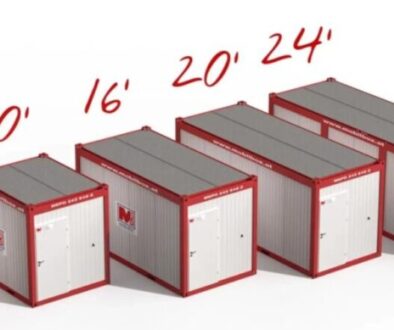
Before you get started, it’s worth familiarizing yourself with the basic technical specifications. MB20H office containers have external dimensions of 6,058 x 2,438 x 2,800 mm . With these dimensions, we recommend a 2×2 layout, meaning two containers side by side and two in the second row. Remember, the configuration can also be customized – modular technology allows for connections along both long and short sides. The container configuration with internal walls provides a footprint of 59.1 m². Remember, the floor area of a single office container is 14.7 m² . However, after removing the internal walls and installing the flashings, the actual usable area is approximately 60 m². It’s worth noting that the MB20H container is designed for stacking and stacking (up to three stories), which significantly simplifies the assembly process and allows for the later construction of a second or third level, for example, for offices.
2. Container selection and construction basis
Choosing the right containers is key to success. Purchase four identical containers, e.g., MB20H. This involves maintaining exactly the same external dimensions and the spacing of corner holes for mounting tie rods . For used containers, it’s crucial that they have a steel frame without twists or corrosion pits, a non-corrugated roof, and complete corners. The container floor has a permissible load of 200 kg/m², which is the office limit. Of course, the floor’s load capacity can be increased, but this should be determined when ordering the new container. The floor must be adapted to the given load during production. Therefore, the load cannot exceed the previously specified values, which prevents forklift movement. Such a warehouse is ideal for storing lighter goods that can be transported with a duck cart.
3. Formalities and health and safety:
Before beginning installation work, it is necessary to complete all formalities. A container warehouse can be considered a construction facility, so before construction begins, consult with your local authority to determine whether a notification or building permit is required. It is also important to plan fire safety measures, such as fire escapes, fire extinguishers, and emergency lighting. It is also important to remember occupational health and safety regulations during installation. Work on the roof should be performed with a safety net, and safety glasses should be worn when replacing panels.
4. Foundation: are foundations needed?
The robust construction of office containers allows them to be placed on concrete blocks or on a flat, hard surface, such as a concrete or asphalt yard, or on an industrial floor inside a warehouse. It is also possible to base the warehouse on a point foundation under each corner of the module. It is crucial that any foundation option provides a single, flat surface for the entire structure.
5. What is the order of work?
The work schedule is crucial for efficient and safe installation.
- Stage A – Preparation: includes preparing a ground floor drawing, formal arrangements, planning and preparing the site, planning access for a truck with an HDS crane.
- Step B – Dismantling the walls: remove the interior wall panels, leaving the structure aside. Set the dismantled panels aside in a safe place; you may want to reinstall them at some point. Reinstalling the panels can be accomplished by removing the tie rods and moving the containers apart.
- Step C – Module Setup: Position and connect the containers with tie rods. Inter-container seals should be used.
- Stage D – Entrance gate: after installing the modules, we dismantle the external panels and replace them with wide doors.
- Entrance gates – variants:
- variant: gate on one short side
- variant: gate on the long side
- Step E – Roof and Drainage: We seal the roof joints. We don’t install gutters in the office container; the water drains inside the columns.
- Step F – Electrical: Electrical installation should only be performed after the structure has been sealed. We recommend having a licensed electrician perform the electrical work. This will ensure safety during future use.
6. Safety and durability: what to avoid?
To ensure the durability and safety of the structure: Never cut the container frame profiles! Remember that the MB20H container floor has a load limit of 200 kg/m², so it is not suitable for storing heavy goods.
Never tamper with the floor yourself to increase its load-bearing capacity. Container design parameters may only be changed at the factory during production, under the supervision of specialists.
Take care of safety – Don’t forget to have in your warehouse:
- Fire extinguishers: min. 2 × 6 kg (powder or foam) at ~60 m²;
- “Exit” signage and pictograms.
- Exit lighting .
Benefits of storing office containers in the MB20H
- Quick assembly – the warehouse is ready in a few days.
- Mobility – can be easily dismantled and moved to another location.
- Flexibility – possibility of expansion with additional modules or floors.
- Lower investment costs – a much cheaper investment than building a classic hall.
- Security – solid steel construction, possibility of alarm and monitoring protection.
- Aesthetics – office containers have a modern look and fit better into the surroundings than typical shipping containers.
- Arrangement – inside and outside, at any time, you can arrange the warehouse into an office with a new aesthetic facade.
- Thermal insulation – the walls of the MB20H container are insulated with mineral wool, which makes it easier to maintain a stable temperature inside.
- Lower heating costs – thanks to insulation, less energy is needed to heat the space in winter than in the case of shipping containers.
- Ready-made electrical installation – the container is factory-equipped with a switchboard, sockets and lighting, which makes it easy to adapt to the warehouse function.
- Possibility of connecting heating – electric heaters ensure comfort of use in the colder months, making such a warehouse year-round and more functional.
| Characteristic | MB20H office containers | Sea containers | Storage containers |
| Destiny | prefabricated modules, easy to connect and arrange | maritime transport, storage of heavy loads | simple structures for storing goods |
| Usable area | easily combined into an open space, aesthetic interior | limited, no possibility of large openings without reinforcements | mostly single spaces |
| Floor load capacity | 200 kg/m² (office) | very high (pallets, heavy equipment) | average, depending on the type |
| Appearance and comfort | aesthetic, insulated, easy to adapt | raw, steel, require adaptation and insulation | simple, functional, but less aesthetic |
| Costs | moderate, lower than the construction of a hall | often cheap to buy, more expensive to adapt | affordable, limited arrangement options |
| Expansion possibilities | stacking and combining into modules | limited, require welding and reinforcement | rather lack of systemic expansion |
A modern container warehouse with an area of approximately 60 m², equipped with a wide door, electrical installation, and lighting. This solution combines the flexibility of modular construction with practical functionality.
With MB20H office containers, you can quickly create a container warehouse tailored to your needs – from storing tools and materials, through storing goods, to a workshop.